


An electric fence may look like a simple row of taut wires mounted along a wall or across a pasture, yet behind that clean exterior lies a finely balanced electrical circuit. Every single piece of hardware in the installation—from the high-voltage energizer tucked inside a utility room down to the smallest plastic insulator or spring tensioner—plays a specific role in maintaining pulse strength, preventing voltage leaks, and triggering instant alerts when a perimeter is challenged.
Understanding how each component functions, and what separates heavy-duty hardware from cheap substitutes, helps property owners, installers, and facility managers make smarter purchasing decisions and avoid chronic maintenance headaches. Below is a complete, component-by-component breakdown of a modern electric fence system.
1. The Energizer (The Heart of the System)
The energizer (sometimes called a fence charger or controller) is the central brain and power source of the entire perimeter. Its primary job is to convert low-voltage input power—either 110V/240V AC mains electricity or 12V DC battery/solar energy—into controlled, high-voltage pulses of 6,000V to 10,000V delivered roughly once per second.
Modern energizers fall into two main categories depending on the application:
- Agricultural Energizers: Designed primarily to deliver a strong physical shock to livestock or wildlife across long distances and through moderate grass or weed contact. They are rated by stored and output Joules (ranging from 0.5J for small paddocks to 20J+ for multi-kilometer ranches).
- Security Energizers: Engineered specifically for residential, commercial, and industrial perimeters. Beyond delivering a deterrent shock, security energizers continuously measure the return voltage coming back from the end of the fence loop. If a wire is cut, tampered with, or shorted out, the unit immediately triggers sirens, strobe lights, and alarm transmitters. Advanced security models also offer multi-zone monitoring, keypad or mobile app control, and high/low voltage modes (allowing daytime low-voltage monitoring when staff or gardeners are working near the wall).
2. Conductive Fence Wires
The conductive wires form the physical barrier that carries high-voltage pulses around your perimeter. Choosing the right conductor affects both electrical performance and lifespan, because different metals offer vastly different levels of electrical resistance and corrosion resistance.
| Wire Type | Conductivity | Corrosion Resistance | Best Application |
| High-Tensile Galvanized Steel (2.0mm – 2.5mm) | Moderate | Good (Heavy-duty Class 3 galvanizing lasts longest) | Permanent agricultural fences and sturdy free-standing perimeters |
| Aluminum / Aluminum-Magnesium Alloy (1.6mm – 2.5mm) | Very High (~4x better than steel) | Excellent (Naturally forms protective oxide layer) | Long commercial perimeters, coastal properties, and high-salt/humid climates |
| Braided Stainless Steel (1.2mm – 1.6mm) | Lower than steel/aluminum | Superior (Virtually rust-proof) | Top-wall residential security fences where flexibility around tight corners matters |
| Polywire & Polytape | Moderate–High (depends on stainless/copper strands) | Excellent (UV-stabilized plastic + metal filaments) | Temporary rotational grazing paddocks and portable enclosures |
Installer Tip: Never mix different metals directly (such as twisting bare copper wire onto galvanized steel wire) without using bi-metallic line clamps. Direct contact between dissimilar metals causes galvanic corrosion, which quickly rusts through the connection and creates high electrical resistance.
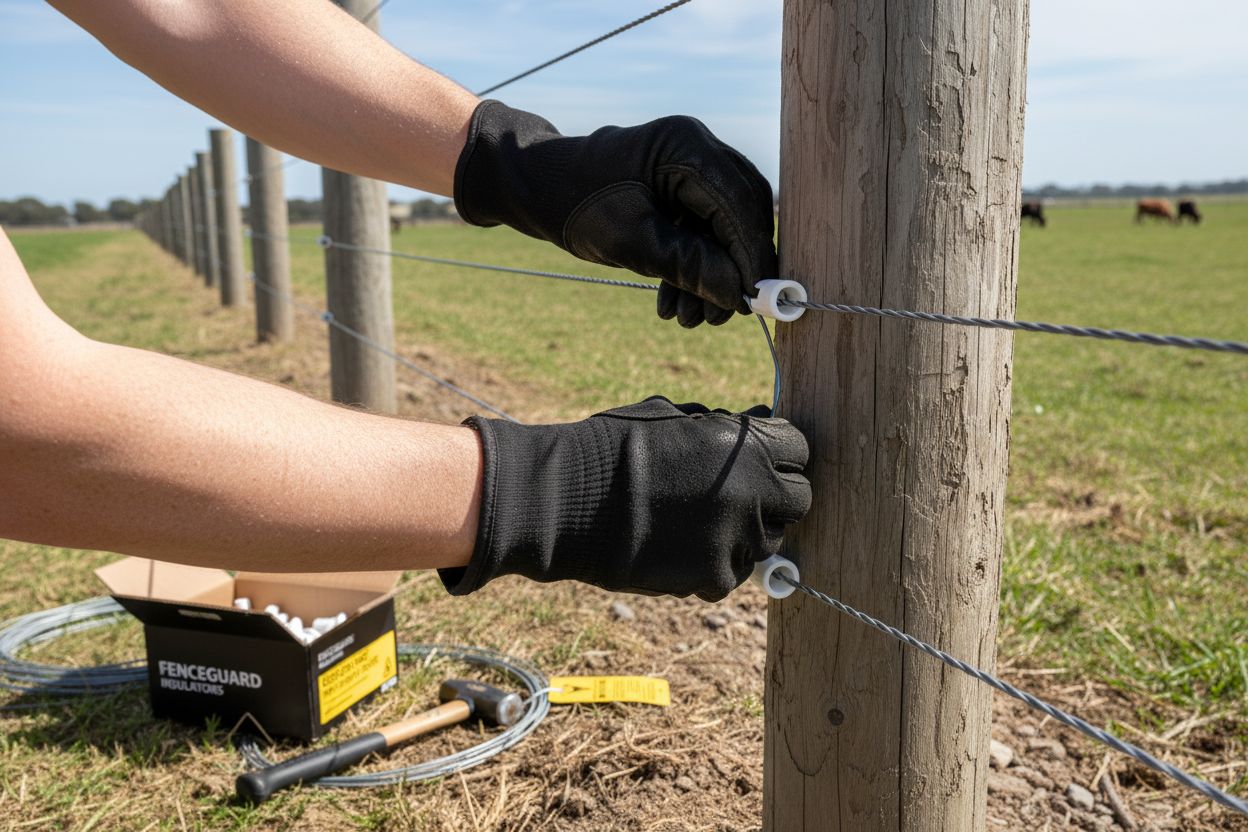
3. Insulators (Keeping Power on the Line)
Electricity always seeks the easiest path to the ground. Because metal brackets, steel posts, wet timber, and masonry walls all conduct electricity to varying degrees, every live wire must be physically isolated from its support structure using insulators.
Quality insulators are molded from UV-stabilized High-Density Polyethylene (HDPE), heavy-duty polycarbonate, or glazed porcelain, engineered to withstand 10,000V+ without arcing through the plastic. Common types include:
- Line / Intermediate Insulators: Clip onto flat-bar, square-tube, or round posts along straight runs to hold the wire securely while allowing slight longitudinal movement during temperature expansion.
- Strain / End Insulators (Bobbin or Bullnose Insulators): Heavy-duty, thick-walled insulators placed at corners, gates, and wall ends where wires are pulled tight under high tension. Cheap strain insulators often crack under mechanical load, letting the live wire touch the corner bracket and short out the entire fence.
- Offset (Stand-Off) Insulators: Extend a live wire 15 to 30 centimeters out from an existing non-electric fence (such as chain-link or wooden palisade) to stop animals or intruders from leaning against or climbing over the main barrier.
4. Posts, Wall Brackets, and Strainers
The structural framework holds the wires at the proper height, spacing, and tension:
- Wall-Top Security Brackets: Used on perimeter masonry walls, typically fabricated from hot-dip galvanized steel, powder-coated steel, or aluminum. They come in straight, angled (45-degree outward or inward), and Y-shaped profiles, usually carrying between 6 and 12 wire strands spaced 100mm apart so nobody can squeeze between them.
- Free-Standing Line & Corner Posts: For ground-level installations, sturdy strain posts (heavy steel pipe, treated hardwood, or concrete) are concreted into the ground at corners, gate openings, and every 50 to 100 meters to absorb wire tension, while lighter intermediate posts (fiberglass, Y-standards, or lighter steel) support the wire every 3 to 5 meters in between.
5. Wire Tensioners and Tension Springs
A saggy electric fence is both easy to bypass and prone to false alarms when wind blows adjacent wires together. To keep wires drum-tight across changing temperatures:
- Inline Wire Tensioners (Ratchet Strainers): Installed along each strand so technicians can crank the wire taut with a tensioning tool and lock it in place.
- Tension Springs (Compression or Extension Springs): Placed inline with the wire to absorb thermal expansion and contraction. In hot midday sun, metal wires expand and lengthen; at night, they contract. Springs automatically take up the slack without snapping corner brackets or stretching wires past their breaking point.
6. The Grounding (Earthing) System
Even the strongest energizer will fail if the grounding system is weak. The earthing setup provides the return pathway through the soil back to the energizer when an intruder or animal touches a live wire. Key grounding components include:
- Earth Stakes (Ground Rods): 1.2-meter to 2-meter galvanized steel or copper-clad steel rods driven deep into damp soil, spaced at least 3 meters apart and wired together in series.
- Earth-Return Wires: In dry regions, rocky soil, or high wall-top installations where someone scaling a wall might not be touching the ground directly, installers alternate live (+) wires with grounded (–) earth wires on the brackets. Touching any two adjacent strands completes the circuit immediately, regardless of soil moisture.
7. High-Voltage Lead-Out (Under-Gate) Cable
Standard household electrical wire is only insulated for 600V to 1,000V. If used on an electric fence, 8,000V pulses will punch straight through the insulation, leaking power into walls, conduits, or soil.
Instead, installers use double-insulated High-Voltage (HT) Lead-Out Cable—featuring a thick galvanized or tinned-copper core wrapped in heavy polyethylene insulation rated for 15,000V to 20,000V. This specialized cable safely carries power from the energizer out to the fence line, jumps across zones, and runs underground beneath driveways and sliding gates without losing voltage.
8. Gate Contacts and Gate Handles
Gates are the weakest structural point of any perimeter, yet they must open and close smoothly dozens of times a day without interrupting the fence circuit:
- Sliding & Swing Gate Contacts: Spring-loaded brass or stainless-steel contact plates mounted on the gate post and gate leaf. When the gate closes, the contacts press together automatically, passing high-voltage power across the gate wires; when the gate opens, power to the gate wires disconnects safely while the rest of the perimeter remains live.
- Insulated Gate Handles: Used on farm and paddock gates, combining a heavy-duty insulated rubber or plastic grip with an internal spring hook so livestock handlers can unhook a live strand safely without getting shocked.
9. Surge Protection, Cut-Off Switches, and Warning Signs
Finally, three critical accessory components protect both the equipment and the people around it:
- Lightning Diverters and Chokes: Installed where the fence line enters the energizer, these devices route high-energy lightning surges safely into a dedicated earth rod before they can fry the energizer’s circuit board.
- Cut-Off (Isolator) Switches: Weatherproof rotary or knife switches placed at zone junctions so technicians can turn off power to one section of the fence for repairs while keeping the rest of the property protected.
- Warning Signs: Bright yellow, UV-resistant regulatory signs clamped onto the fence wires at regular intervals (every 10 meters in urban areas and at all access points) to warn the public of the live electric barrier and satisfy legal safety requirements.