


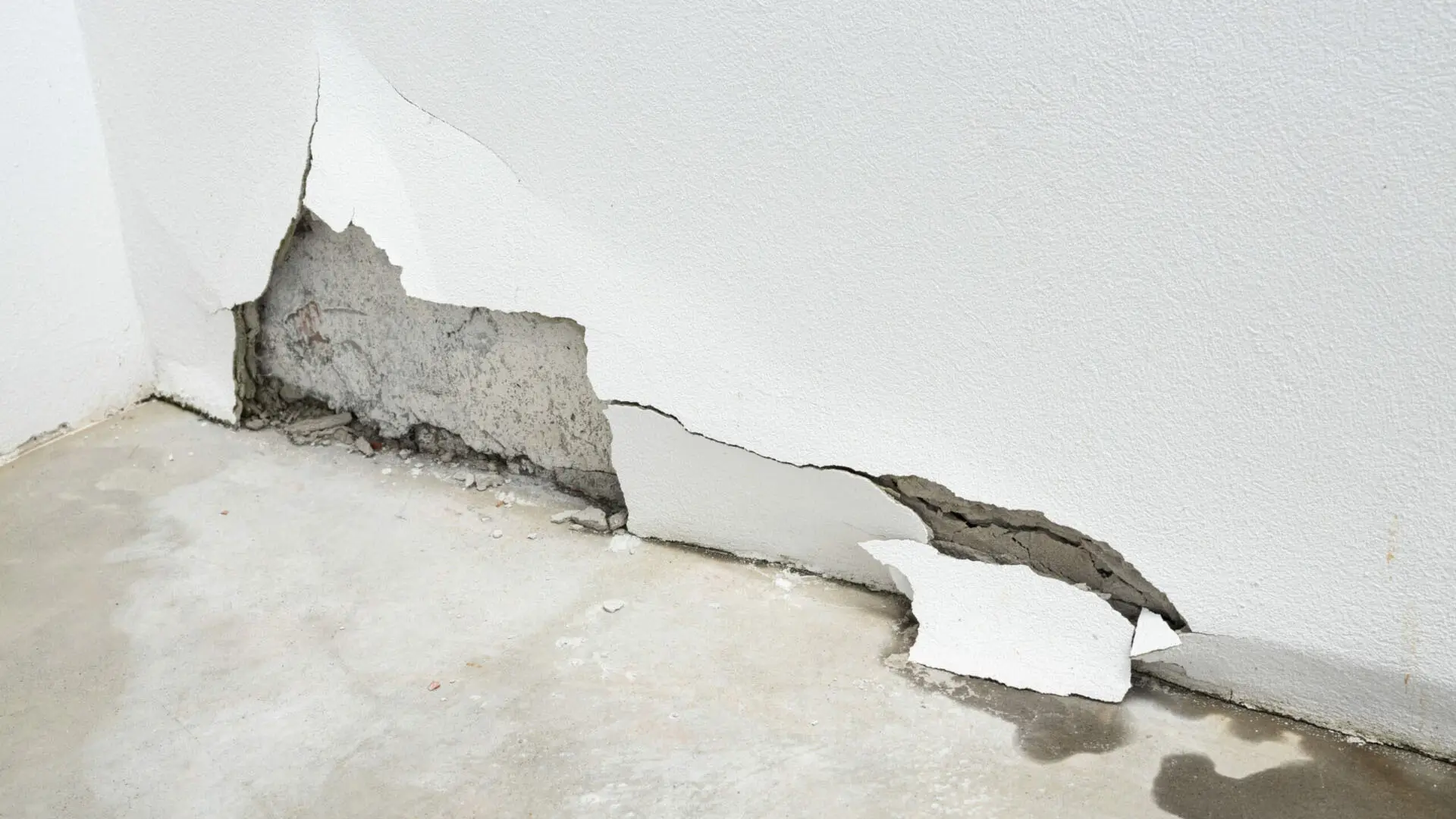
Water damage is seldom conspicuous. The costliest repairs don’t result from the burst pipes you spot – they come from the slow, concealed invasions that seep silently within your walls, floors, and foundations for months on end before you detect any telltale signs.
The foundation zone: where water pressure works against you
Most homeowners focus on water seepage from above, but the bigger risk is water pushing up from below.
When the soil around your foundation stays wet due to an improper landscaping grade, gutter clogs, downspouts that dump water too close to your house, or all of these combined, the moisture accumulates in the form of hydrostatic pressure against your slab and basement walls. Water doesn’t need a crack to enter; it simply flows through the capillaries or microscopic pores in concrete, and rises upward, infiltrating floors and the framed walls above.
Efflorescence is an early warning sign that homeowners often overlook. The white, powdery residue on concrete or brick is caused by minerals being carried to the surface as water moves through the foundation and evaporates. It is more than a cosmetic issue; it indicates that moisture is actively passing through the masonry.
Relieving the pressure on the foundation by directing water away from the house with proper grading/french drain can make a big difference, but if water is already inside the slab, you need extraction, not just a diversion.
Hidden appliance leaks: the slow rot under your floors
Major leaks from burst pipes are attention grabbing – and structural damage from a ruptured pipeline undoubtedly poses a huge and immediate problem. However, it is the little leak, the one that weeps a teaspoon of water a day, the unnoticed pipe behind a wall that nobody has seen since it was first installed – it’s the sum of these little and unnoticed leaks that can destroy a house.
Slow leaks can cause more damage over time than major pipe failures because they quietly soak the subfloor and framing for months. By the time you notice soft spots, cracked tiles, or a wooden floor flexing underfoot, the damage may already be extensive.
Check rubber supply hoses on appliances such as dishwashers and washing machines, and replace ageing hoses with braided stainless-steel alternatives. Also, locate and regularly test your main water shut-off valve so it works when you need it.
The AC condensate line: a clog you won’t see coming
Air conditioning systems remove moisture from the air as they cool it, which is usually drained outside through a condensate line. When this line becomes clogged with algae or debris, particularly in humid conditions, the water has nowhere to go and can begin backing up.
On units located in the attic, the overflow does not drip harmlessly. Instead, it can pour gallons of water directly onto the ceiling joists and drywall beneath, often before anyone notices a problem. The stain in your ceiling might be small, but the damage to the framing and insulation in the space above it is likely extensive.
It takes just minutes to flush the condensate line with a bleach solution once or twice a year. Skip this chore, and you could be spending thousands of dollars repairing your ceiling and the structure above it.
Wall cavities: where window flashing and weep holes fail silently
Window flashing – the metal or membrane material that bridges the potentially problematic gap between a window frame and its surrounding wall – rusts, pulls away, or is never there to begin with on many houses. When it inevitably fails, rainwater penetrates the wall cavity, with nothing to keep it from rotting the structural studs or saturating the insulation and drywall.
This same underlying problem arises with weep holes in brick veneer. The small openings along the bottom course of brick are there to help moisture that’s blown or rained into the cavity escape instead of being trapped. If those openings become clogged with dirt or debris, water pools inside the cavity.
The maddening part is that neither failure tends to make fast work of interior drywall. Instead, the relative humidity of the entire wall jumps, the framing starts sopping up water, and mold blooms long before you see even a dime-size stain. By the time the paint blisters and peels or the paper on the drywall facing starts to delaminate because the gypsum core has turned to powder, the structural wood is probably already toast.
Homeowners who do notice any of the common warning signs – soft or peeling drywall, unexplained rise in humidity, visible mineral deposits on the wall – are encouraged to get a Water damage restoration Mesa, AZ professional with industrial dehumidifiers and moisture meters to see what’s happening inside the wall before mold takes root.
Why the 24-48 hour window matters more than most people realize
Claims related to water damage and freezing constitute around 29% of homeowner insurance losses (as reported by the Insurance Information Institute). This statistic shows how many cases of leaks and floods are ignored or only partially mitigated, resulting in extensive damage.
When the framing of a building becomes saturated with water, mold colonies can establish themselves within one to two days. Turning on the home’s fans will have minimal, if any, impact on the moisture contained behind walls, under cabinetry, or within ceiling joists. The building structure remains damp, and the cost of the repairs climbs even higher, as the mold spores will need to be addressed during the restoration process.
Professional water extraction uses equipment to remove moisture directly from affected structural materials – not just from the air surface. That difference is what keeps a water intrusion event from becoming a full mold remediation project.
The costliest damage occurs when homeowners don’t find the source of the water in time. Leaks in the home can go undetected for months or even years if they are in an out-of-the-way location such as under an appliance, sink, or around a window frame. Or hidden by stored materials in the basement, behind a wall where a pipe is leaking, or inside a roof or mechanical system.